Hi-Yield Atrazine Weed Killer
Atrazine at 4% clears listed broadleaf and grassy weeds out of a St. Augustine or Centipede lawn without taking the grass with them. It works on weeds that are already up and on susceptible weeds still coming from seed, so one measured pass covers both stages. A single quart treats up to 3,720 square feet.
Which Bottle to Buy

32 fl oz · 946 mL
32 oz Concentrate
Measured into a pump sprayer you already own. The format when the rate has to be exact, or when one problem area is all that needs treating.
- Treats up to 3,720 sq ft at the labeled rate
- Works with any pump sprayer you can fit a flat-fan tip to
- Mixes down to a 100 sq ft batch without opening the whole job
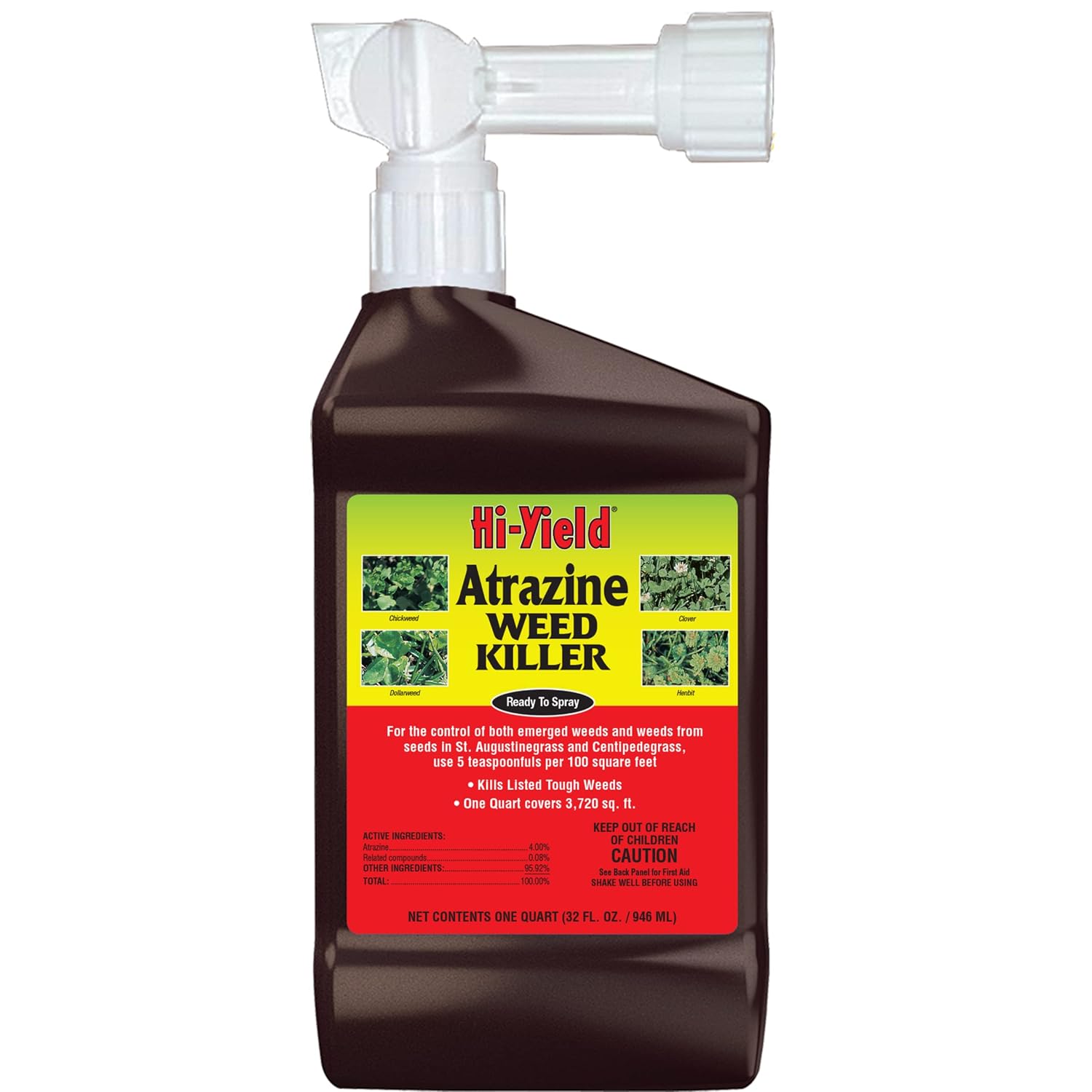
32 fl oz · 946 mL
32 oz Ready To Spray
Screws onto a garden hose and meters itself as you walk. The format for covering a whole lawn in one pass.
- Treats up to 3,720 sq ft at the labeled rate
- No measuring cup and no separate sprayer to clean
- Needs a hose that reaches the far corner of the lawn
Is Your Grass on the Label?
Labeled for
- Established St. Augustinegrass
- Established Centipedegrass
Established means a lawn that has knitted together and been through at least one full growing season in place.
Not labeled for
- Bermudagrass
- Zoysiagrass
- Bahiagrass
- Tall fescue
- Kentucky bluegrass
- Perennial ryegrass
- New sod, fresh sprigs and any lawn still filling in
Telling the two apart
St. Augustinegrass has wide flat blades with a rounded tip, and thick above-ground runners you can lift off the soil with a finger. Centipedegrass is finer and a paler yellow-green, with short leaves set at close intervals along its runners. The species most often mistaken for centipede in a Southern yard is bermudagrass, which has thin pointed blades and a seed head shaped like a bird's foot.
Pull a plug and take it to a county extension office if you are not certain. Atrazine on the wrong turf is not a mistake you can undo, and other atrazine products carry different labels, so a rate you read somewhere else does not transfer to this bottle.
Hi-Yield Atrazine Mixing Instructions
| Area to treat | Hi-Yield Atrazine | Water |
|---|---|---|
| 100 sq ft | 5 teaspoons | At least 1 quart |
| 500 sq ft | 4.3 fl oz | At least 1 gallon |
| 1,000 sq ft | 8.6 fl oz | At least 2 gallons |
The full quart therefore covers around 3,720 square feet. Water volume is the flexible part of the recipe, since it only has to be enough to spread the dose evenly over the ground you measured. The amount of concentrate is fixed.
8.6 fl oz per 1,000 sq ft is a ceiling
That figure is the maximum for a single application, and two applications is the most any area receives in one year. Neither number bends because the weeds look bad.
Going over the rate injures St. Augustine and Centipede instead of working faster, and a third pass over the same ground in one season is not permitted at any strength.
Water is the only thing you add
Combinations with other chemicals in the application mixture are not recommended for this product, so nothing else goes in the tank alongside it.
Directions change over the life of a pesticide. The bottle in your hand governs its legal use, which means an older rate or a generic atrazine recommendation found elsewhere does not apply to it.
Measure the lawn, not the tank
Start by pacing out the area you intend to treat and calculate from that number. A sprayer tank tells you how much liquid you are carrying, never how much ground you are covering.
Hold the nozzle low, roughly twelve inches off the blades, and lay the passes edge to edge in strips a little over a yard wide. Every overlap doubles the rate on that strip, which is where most turf damage starts. Treating the whole lawn evenly at the correct rate is safer than hitting only the visible patches, because spot spraying concentrates the dose onto small areas even though your calculation assumed the full square footage.
How to Apply It
- 1Shake the bottle before anything comes out of it.
- 2Pace out the treatment area and work the concentrate amount from the table above. The number of square feet decides everything that follows.
- 3Pour the measured concentrate into the sprayer, then add the water the rate calls for.
- 4Fit a flat-fan tip and spray a coarse, low-pressure pattern across the turf in even passes.
- 5Keep the spray off people, pets, ornamental plants and standing water. Nobody walks back on until it has dried.
An uneven spray pattern leaves untreated strips in one place and a double dose in another, so calibration is worth more than sprayer capacity. Never spray in wind. Drift carries atrazine onto plants that have no tolerance for it, and the damage turns up days later on ground you never intended to treat.
Weeds already up
Keep water off
The concentrate asks for 24 to 48 hours without irrigation or rainfall after treatment. The Ready To Spray asks for 72.
Water inside that window rinses product off the leaf before the plant has taken enough of it in. This is the most common reason a correctly measured application underperforms.
Weeds still in the seed
Water within 7 to 10 days
Rainfall or irrigation carries atrazine down into the top layer of soil, which is where germinating weeds pick it up.
Without that moisture the pre-emergent half of the job never happens, and the residual control you paid for stays sitting on the surface.
One application aimed at both stages runs those two rules in order. Stay off the lawn first, then water it in before the ten day mark if no rain has arrived on its own.
When to Spray
Early spring and dormant periods are the general window. Weeds are easiest to kill young, so a useful application lands either just after they emerge or shortly before they do. Local weather shifts turf development from one year to the next, which is why the calendar below is a starting point rather than a schedule you can set once and reuse.
Conditions that have to hold
- Air temperature below 90°F
- Turf healthy rather than fighting drought, heat, insects, nematodes or disease
- Weeds still small, or the ground treated shortly before they germinate
- Summer treatments kept to spot applications
| Target | Timing |
|---|---|
| Listed weeds generally | Early spring or during dormancy, while weeds are small or before they emerge |
| Spurweed | December and January, as soon as it has emerged |
| Florida betony | Mid to late October, then again mid to late February |
| Dichondra and moneywort | Early April, then again in July |
| Summer | Spot treatment only |
Give it three weeks
Nothing looks different on day seven. Atrazine is a triazine herbicide that interferes with electron transport in Photosystem II, the step a plant uses to turn light into food. A treated weed stops feeding itself and then runs down, which takes two to three weeks to become obvious. Ten days of no visible change is a normal result rather than a failed application.
Selectivity works the same way. Appropriately labeled turfgrass tolerates a rate that shuts susceptible weeds down, which is the entire reason a St. Augustine lawn survives a treatment that takes out the dollarweed growing through it.
What It Controls
Broadleaf weeds
- Common Chickweed
- Mouseear Chickweed
- Cransbill
- Cudweed
- Dichondra
- Florida Betony
- Henbit
- Knotweed
- Lespedeza
- Moneywort
- Mustards
- Narrowleaf Vetch
- Parsley-Piert
- Pennywort (Dollarweed)
- Spurge
- Spurweed
- Swinecrest
- Woodsorrel
- Annual clovers
Grassy weeds
- Annual Bluegrass (Poa annua)
- Sandspur
- Smutgrass
Suppressed only
Crabgrass
Dollarweed
Round leaves on upright stalks, spreading through the damp low spots of a St. Augustine lawn until the separate patches join into one. Atrazine reaches dollarweed that is already up and susceptible plants still coming from seed. Keeping irrigation off for the first couple of days matters more here than almost anywhere else, because dollarweed grows where the ground is wet to begin with.
Spurweed
The sharp burs that make a lawn unwalkable in spring are seed heads, and a plant that has produced them is past the point where treatment helps. December and January are the months that count, while the plant is small, flat and easy to walk over without noticing. A mower scatters mature burs, so one untreated patch becomes several the following year.
Annual Bluegrass
Lighter green clumps that appear in cool months, often before warm-season turf has started growing again. Both halves of the product apply to it. Emerged clumps take atrazine up through the leaf, and seed still in the soil is reached as it germinates. Poa annua is one of the few grassy weeds a St. Augustine lawn can be treated for without harming the turf.
Florida Betony
A perennial that emerges in fall and stores itself underground in white segmented tubers, which is why one spray rarely finishes it. Mid to late October followed by mid to late February is the schedule for it. Those two treatments use the full annual allowance, so a betony program leaves nothing spare for a second problem later in the year.
Crabgrass is suppressed, not controlled
Crabgrass carries the word suppression on the label and that word is doing real work. Expect slower, thinner crabgrass rather than a clear lawn.
If crabgrass is the problem you actually need solved, buy a product labeled for it at the growth stage you are treating and for the grass species you have. Two atrazine applications spent chasing crabgrass leave you with crabgrass and nothing left in the annual allowance for the weeds this product does control.
What to Keep It Away From
Never spray over
- The rooting area of any tree, shrub or ornamental you want to keep
- Vegetable beds and every other desirable plant outside the two labeled turf species
- Ground where drainage runs toward a bed, a hedge or a neighboring yard
- Anywhere inside a greenhouse
- Turf grown for sale as sod, for commercial seed production or for research
Before you renovate
- No overseeding of treated turf for six months after application
- Nothing but the labeled turfgrasses planted in treated ground for 12 months
- Sprigging St. Augustinegrass or Centipedegrass is allowed, with temporary yellowing or stunting possible
Settle the renovation calendar before you spray. Atrazine stays active in treated soil, so a spring application and a fall seeding plan do not fit together.
Roots reach further than the leaves
A shrub's roots commonly run well past the edge of its canopy. Several feet of open ground between the foliage and your spray line is not clearance, only distance from the part of the plant you can see. Treat a bed edge as the start of the root zone rather than the end of it, and look at which way water runs across the yard before the first pass.
Concentrate or Ready To Spray
| 32 oz Concentrate | 32 oz Ready To Spray | |
|---|---|---|
| Atrazine | 4% | 4% |
| Coverage | Up to 3,720 sq ft | Up to 3,720 sq ft |
| Equipment | Compressed-air sprayer with a flat-fan tip | A garden hose |
| Measuring | You measure it into the tank | The bottle meters as you spray |
| Suits | Exact rates and part-lawn treatment | One continuous pass over a whole lawn |
| Product number | 33430 | 33431 |
Application hardware is the whole difference between the two. Both bottles hold the same 4% atrazine and both run into identical restrictions on turf species, weather, annual application count and the plants nearby.
Reach for the concentrate when only part of the lawn needs treating or the treated area has to be measured closely. Reach for the hose-end bottle when a large continuous area is the job and you would rather not calibrate a sprayer for it.
| Active ingredient | Atrazine 4.00%, related compounds 0.08% |
|---|---|
| Size | 32 fl oz / 946 mL |
| Labeled turf | Established St. Augustinegrass and Centipedegrass |
| Use site | Residential lawns |
| Coverage | Up to 3,720 sq ft |
| UPC (concentrate) | 732221334304 |
| EPA Registration No. | 19713-567-7401 |
| Organic | No |
Handling It Safely
What to wear
A long-sleeved shirt, long pants, chemical-resistant gloves, shoes and socks cover anyone handling or spraying it. Wash thoroughly afterward and change out of the clothes you sprayed in. If product gets inside your clothing or gloves, take them off immediately, wash, and put on something clean before going back to the job.
People and pets
Keep everyone out of the area while you are spraying. Entry is fine once the spray has dried. Hi-Yield Atrazine carries the signal word CAUTION and stays out of reach of children at every point between the store and the disposal bin. Avoid contact with skin, eyes and clothing while you work.
Water and runoff
Atrazine can move through soil and reach groundwater under the wrong conditions. Sand and loamy sand with the water table near the surface is the worst case, because those soils are permeable enough for it to travel. Never spray onto water or where surface water is standing, go easy on irrigation afterward, and keep rinse water out of every drain, indoor and outdoor.
Storage and disposal
Store it in its own bottle inside a locked pesticide storage area, away from food, feed and water. The container is non-refillable and should never be reused for anything else. An empty one can be discarded or recycled wherever pesticide container recycling exists. For a partly full bottle you are finished with, call your local solid waste agency rather than guessing.
Where It Ships
Atrazine carries state restrictions on top of the federal ones. The 32 oz concentrate is currently sold in fourteen states, which line up closely with the range where St. Augustine and Centipede lawns are common in the first place.
Everywhere else in the country it is restricted, covering AK, AZ, CA, CO, CT, DC, DE, HI, IA, ID, IL, IN, KS, KY, MA, MD, ME, MI, MN, MT, ND, NE, NH, NM, NV, NY, OH, OR, PA, PR, RI, SD, UT, VI, VT, WA, WI, WV and WY.
State and local requirements change, and some counties add limits of their own on top. Confirm current eligibility before ordering, and follow any state or local pesticide rule that is stricter than the general directions.
Customer Reviews
I need to preface my review by stating that I have treated lawns professionally (am a certified arborist also) but needed to use this product for my own yard. I am very pleased with this Atrizine product but yo...
amerozz
Applied Hi-Yield Atrazine to my St. Augustine grass to control patches of annual bluegrass. I was originally disappointed because after 10 days there was no signs of the Atrazine working. After 3 weeks most ann...
Kraig Kossuth
I use a combination of this Hi-Yield Atrazine Weed Killer along with a prescribed amount of Fertilome Weed-Free Zone mixed together in a 1-gal. pump sprayer to spot spray weeds that invade my yard including com...
frank d.
Am buying this again. Here's the story. In the south there is a weed called known as Burweed, Spurweed, etc..it is NOT sandspurs, the big tall things. These go virtually unnoticeable, but then you start steppin...
cathyv
Weeds were gone in about 3 weeks but I noticed many dying in a week, bought the blue dye and a sprayer and it was easy to follow the instructions. I was a little scared about the chemicals but the sprayer had a...
Gonz
I have a problem with pennywort in my St. Augustine grass. Unlike other weed killers that say it is safe on St. Augustine this actually is. But, you have to be patient. It seemed like nothing was happening to t...
William
About Hi-Yield
Hi-Yield has been part of Voluntary Purchasing Groups since 1976. VPG itself goes back to 1968 and still operates out of Bonham, Texas, where it also owns the ferti-lome and Natural Guard lines. The Hi-Yield range was put together for independent lawn and garden dealers rather than for national chains, and it grew into fertilizers, herbicides and other products aimed at specific yard problems.
Most of what carries the name is a concentrate built for one clearly defined job. Atrazine Weed Killer is narrow even by that standard. It exists because St. Augustinegrass and Centipedegrass tolerate a chemistry that many common broadleaf herbicides cannot safely be used around, and because the South has a set of weeds, dollarweed and Florida betony and spurweed among them, that turn up in those lawns and almost nowhere else.
That narrowness is the value. A herbicide written for two turf species and a defined weed list gives you a rate you can trust on your own lawn, rather than a compromise written to be approximately right for every grass in the country.
Frequently Asked Questions
Hi-Yield Atrazine Weed Killer is a selective herbicide for established St. Augustinegrass and Centipedegrass lawns. It controls listed weeds that have already emerged and also provides pre-emergent activity against susceptible weeds developing from seed. Labeled targets include dollarweed, henbit, chickweed, annual bluegrass, Florida betony, sandspur, spurweed, annual clovers and other broadleaf or grassy weeds listed on the product label.
Hi-Yield Atrazine Weed Killer is labeled for established St. Augustinegrass and Centipedegrass. It should not be applied to other turf species unless the specific product label expressly permits that use. Grass identification matters because herbicide tolerance differs substantially between turf types.
Established St. Augustinegrass tolerates Hi-Yield Atrazine applied at the labeled rate. Turf damage almost always comes from something around the rate rather than from the product itself: too much concentrate in the tank, overlapping passes that double the dose on one strip, spraying above 90°F, or treating a lawn already weakened by drought, insects or disease. Measure the area, mix to the rate and spray in even passes, and the grass comes through the treatment.
A 32 fl. oz. bottle of Hi-Yield Atrazine Weed Killer Concentrate treats up to approximately 3,720 sq. ft. when applied at the labeled maximum rate of 8.6 fl. oz. per 1,000 sq. ft. Actual coverage depends on the measured treatment area and application rate required by the label.
For a 500 sq. ft. treatment area, the labeled rate is 4.3 fl. oz. of concentrate in at least 1 gallon of water. For smaller areas, 5 teaspoons mixed in at least 1 quart of water treats 100 sq. ft. Do not exceed 8.6 fl. oz. per 1,000 sq. ft. in a single application.
Yes. Hi-Yield Atrazine provides post-emergent control of listed weeds that are already growing in the lawn. Results are generally better when weeds are still young and actively susceptible rather than mature and heavily established.
Yes. Atrazine also provides pre-emergent activity against susceptible weeds developing from seed. For this type of control, rainfall or irrigation is needed within approximately 7 to 10 days after application to move the herbicide into the upper soil layer where germinating weeds are affected.
Ten days with no visible change is normal. Atrazine is taken up by the plant and interrupts the process it uses to feed itself, so a treated weed declines gradually instead of collapsing. Most listed weeds look obviously dead somewhere between two and three weeks after treatment. Spraying again inside that window spends one of your two annual applications on ground that was already treated correctly.
Early spring and dormant-season applications are generally preferred, particularly when weeds are small or treatment is made before expected germination. Some weeds have more specific timing. Spurweed is best treated when newly emerged during winter, and Florida betony, dichondra and moneywort each follow their own schedule. Summer applications should be limited to spot treatment.
Watering depends on the purpose of the treatment. When controlling weeds that have already emerged, keep irrigation and rainfall off the lawn for 24 to 48 hours with the concentrate and 72 hours with the Ready To Spray, because early watering reduces post-emergent performance. When pre-emergent control is needed, rainfall or irrigation should occur within 7 to 10 days after application.
Do not make more than two applications to the same area in one year. The maximum labeled rate for an individual turfgrass application is 8.6 fl. oz. per 1,000 sq. ft. Applying additional product beyond the label rate does not improve control reliably and can increase the risk of turf injury or off-target movement.
Do not apply when air temperatures exceed 90°F. Turf that is already suffering from drought, excessive heat, insects, disease or other stress should also be allowed to recover before treatment. Summer use is limited to spot applications.
Atrazine should be kept away from the root zones of trees, ornamental plants, vegetables and other desirable plants that are not listed for treatment. Spray drift, runoff and treated soil can injure sensitive vegetation. Avoid applying near landscape beds or locations where drainage could carry the herbicide toward desirable plants.
People and pets should remain outside the treatment area during application and should not return until the spray has dried. Applicators wear the protective clothing and chemical-resistant gloves the product calls for, including a long-sleeved shirt, long pants, shoes and socks.
The 32 oz. concentrate is measured and diluted with water in a separate garden sprayer, making it useful when precise rates or smaller treatment areas are important. The Ready To Spray version connects directly to a garden hose and meters the product during application. Both contain 4% atrazine and are designed for the same labeled St. Augustinegrass and Centipedegrass uses.
The bottle reads Hi-Yield, with a hyphen. Hi Yield and High Yield are how a great many people type it, and all three spellings point at the same product. To be certain which formulation is in your cart, look for Atrazine Weed Killer on the front panel, 4.00% atrazine in the ingredient panel and EPA Reg. No. 19713-567-7401.
Hi-Yield is one of the brands of Voluntary Purchasing Groups, Inc. The line covers herbicides, insecticides, fertilizers and other products for residential lawn and landscape care, and it reached homeowners through independent garden dealers rather than national chains.
No. Atrazine products are subject to federal, state and sometimes local pesticide regulations, and Hi-Yield Atrazine Weed Killer is not available for sale in every jurisdiction. Availability should be confirmed before ordering. Regardless of location, the directions and restrictions on the label attached to the product must be followed exactly.

Get the Rate Right the First Time
Work out the square footage before anything goes in the tank. The concentrate amount and the water volume both follow from that one number, and so does which of the two bottles is worth buying.
Shop Hi-Yield Atrazine